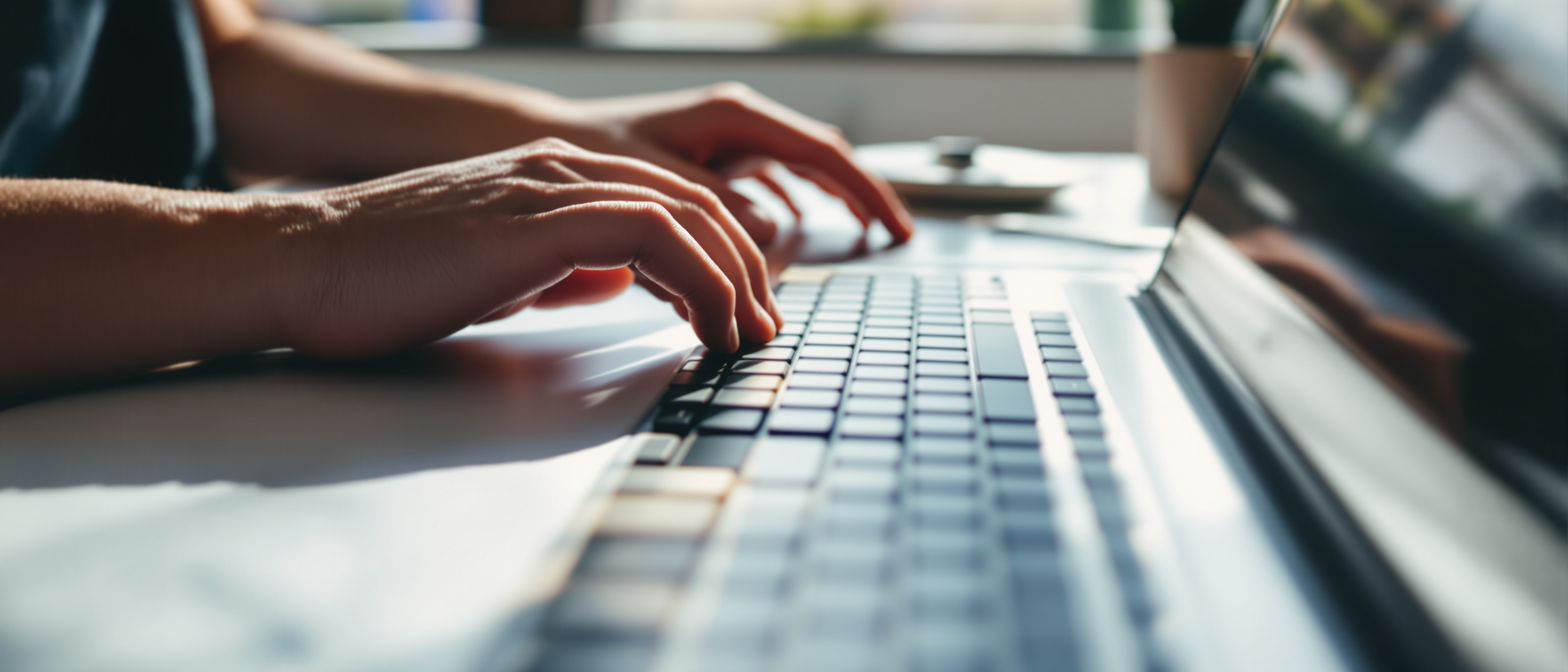
You're in the middle of an important project, thoughts flowing clearly in your mind, but your fingers can't keep up. You watch your cursor blink mockingly as you hunt for keys, backspace to fix typos, and lose your train of thought in the process.
Or perhaps you've noticed your colleagues finishing tasks faster than you. Same workload, same tools, but somehow they're always done first. You start to wonder—is it your typing speed holding you back?
Maybe you're job hunting, and you see "50+ WPM typing speed required" in job descriptions. You have no idea if you meet that requirement because you've never actually tested your typing speed. The uncertainty is frustrating.
These scenarios play out thousands of times every day. In our keyboard-driven world, typing speed isn't just a nice skill to have—it's a fundamental productivity factor that affects almost everything you do on a computer.
The Hidden Cost of Slow Typing
Let's do some quick math. If you type at 35 words per minute and spend just three hours a day typing (emails, reports, messages, documents), that's about 6,300 words typed daily. Over a year? That's roughly 1.5 million words.
Now imagine you could type at 60 words per minute instead. You'd complete that same amount of work in less than two hours. That's an hour saved every single day—250 hours per year. That's more than six full work weeks.
But the cost isn't just time. There's the mental cost of breaking your flow every time your fingers lag behind your thoughts. There's the professional cost when slow typing makes you appear less competent than you actually are. There's the opportunity cost—projects you could have tackled, skills you could have learned, or simply time you could have spent away from your desk.
And here's what many people don't realize: typing speed isn't fixed. It's a skill you can improve, often dramatically, with awareness and practice. But first, you need to know where you stand.
Why Most People Never Test Their Typing Speed
Despite typing being a daily activity for billions of people, most have never actually tested their speed. Why?
Fear of disappointment: What if you discover you're slower than you thought? What if the result confirms you're "bad at typing"? It's easier not to know than to face potentially discouraging numbers.
Complicated tools: Many typing tests require downloads, installations, or registrations. When you just want a quick check of your speed, a complex setup process kills the motivation.
Unrealistic test conditions: Some tests use bizarre texts, weird formatting, or artificial conditions that don't reflect real-world typing. The results feel meaningless because they don't match how you actually type.
No context for results: You finish a test and see "42 WPM." Is that good? Bad? Average? Without context, the number is just... a number. You don't know if you should celebrate or be concerned.
No clear path to improvement: Even if you test your speed, then what? Most tools just give you a score and send you on your way. They don't help you understand what to improve or how to get better.
What Makes a Good Typing Test?
After researching how people actually want to measure and improve their typing, we identified what truly matters in a typing test:
Instant accessibility: No downloads, no accounts, no barriers. Open your browser, start typing, get results. The test should respect your time by not wasting it on unnecessary steps.
Realistic test content: You should type real words and sentences that feel natural, not random character strings or obscure vocabulary. The test should reflect actual typing scenarios you encounter daily.
Accurate measurements: Both speed (words per minute) and accuracy (error rate) matter. A test that only measures one gives you an incomplete picture of your typing ability.
Clear, contextualized results: Raw numbers are meaningless without context. You need to know how your speed compares to averages, what your accuracy says about your typing habits, and whether your results qualify for various professional requirements.
Actionable insights: The best test doesn't just measure—it teaches. It shows you where you struggle, which errors you make most often, and provides clear direction for improvement.
How Our Typing Test Helps You Improve
We built our typing test tool with a simple philosophy: measurement should lead to improvement. Here's what happens when you use it:
Immediate start: No setup, no instructions to read through, no tutorial to complete. Just start typing the text shown on screen. We respect that you know how keyboards work.
Real-time feedback: Watch your WPM and accuracy update as you type. This isn't just for show—seeing your stats in real-time helps you develop awareness of when you speed up, slow down, or make errors.
Natural test content: We use everyday language—the kind of sentences you might actually type in emails or documents. This makes results meaningful because they reflect your real-world typing ability.
Comprehensive results: When you finish, you get your words per minute, accuracy percentage, and time taken. But more importantly, you get context—how you compare to average typists, what your speed qualifies you for, and what your accuracy reveals about your typing technique.
Try again without barriers: Want to improve your score? Just take the test again. No daily limits, no waiting periods, no "premium" features required for retakes. Practice as much as you want.
Real People, Real Progress
The job seeker who gained confidence: Marcus was applying for administrative positions that required "minimum 45 WPM." He had no idea if he qualified, and the uncertainty was stressful. After taking our test and discovering he typed 52 WPM, he applied with confidence—and landed the job.
The writer who found her bottleneck: Emily knew she was slower than other writers but didn't know why. Our test revealed she typed at only 28 WPM with 75% accuracy. She realized her hunt-and-peck technique was the bottleneck. After learning proper touch typing, she now averages 65 WPM and has doubled her writing output.
The student who improved his efficiency: Jake spent hours typing notes and assignments. Testing revealed he was faster than he thought (55 WPM) but had only 82% accuracy—meaning significant time wasted on corrections. By focusing on accuracy over speed, he improved to 96% accuracy, and ironically, his overall speed increased to 62 WPM as he made fewer errors.
The professional who tracked progress: Sarah used our test weekly while practicing typing improvement. Watching her progress from 38 WPM to 65 WPM over three months was incredibly motivating. Each small improvement became a milestone that encouraged her to keep practicing.
Understanding Your Results
Let's decode what typing test results actually mean:
Below 30 WPM: This is hunt-and-peck territory. You likely look at the keyboard frequently and use only a few fingers. The good news? You have enormous potential for improvement with proper technique.
30-40 WPM: This is where many casual typists land. You're functional but likely losing significant time on typing-heavy tasks. Learning touch typing could easily double your speed.
40-50 WPM: You're approaching average adult typing speed. This is sufficient for most jobs but leaves room for improvement that would make daily tasks noticeably faster.
50-60 WPM: This is solid, above-average typing. You meet requirements for most administrative and professional positions. Small improvements here yield big time savings.
60-80 WPM: You're a fast typist. Your typing speed rarely limits your productivity, and you likely use proper touch typing technique.
Above 80 WPM: You're in the top tier of typists. At this level, your fingers truly keep up with your thoughts, and typing feels almost automatic.
Remember: accuracy matters as much as speed. Typing 70 WPM with 70% accuracy means you're spending significant time fixing errors. But 50 WPM at 98% accuracy is more productive because you rarely have to backtrack.
How to Actually Improve Your Typing Speed
Testing is just the first step. Here's how to turn awareness into improvement:
Learn proper finger placement: If you're hunt-and-peck typing, learning which fingers should hit which keys is the single biggest improvement you can make. Touch typing feels awkward at first but becomes automatic with practice.
Focus on accuracy first, speed second: It's tempting to type as fast as possible, but errors slow you down more than deliberate, accurate typing. Master accuracy, and speed will naturally follow.
Practice with real content: Don't just do typing drills with random text. Practice by typing things you actually need to write—emails, documents, notes. This builds relevant muscle memory.
Test regularly to track progress: Take our typing test weekly to see your improvement. Watching your numbers climb is incredibly motivating and helps you identify when specific practice techniques are working.
Don't look at the keyboard: This is hard at first but essential for real speed improvement. Cover your keyboard if you must. Your fingers know where the keys are—trust them.
Maintain good posture: Sit up straight, keep your feet flat on the floor, and position your keyboard at the right height. Physical comfort directly affects typing speed and reduces fatigue.
Why We Made This Free
Typing speed testing shouldn't require payment. It's a basic measurement tool that helps people understand their skills and improve their productivity. Making it free and accessible means anyone can benefit, regardless of their budget.
We believe that in a world where keyboard skills matter for education, employment, and daily life, the tools to measure and improve those skills should be universally available.
Take the Test Right Now
You don't need to prepare. You don't need to warm up. Just open our typing test and start typing. In 60 seconds, you'll have a clear picture of your current ability.
Maybe you'll discover you're faster than you thought, which is always a confidence boost. Maybe you'll identify room for improvement, which is the first step toward becoming more productive. Either way, you'll have data instead of assumptions.
Because the difference between wondering how fast you type and knowing how fast you type is just 60 seconds away.
Your keyboard is waiting. Find out what you're capable of.